
Traumatic Hemothorax

Case: 18 y/o M is wheeled in with a stab wound to the left chest. VS: HR 130, BP 95/45, RR 30, SpO2 92% on 15L NRB. Pt is maintaining airway, no tracheal deviation, diminished BS on the left, strong distal pulses. You place a left-sided 36F chest tube with immediate blood return. 

What are the possible etiologies of traumatic hemothorax?

Laceration/injury to the heart, major vessels, intercostal vessels, mammary arteries, thoracic spine, diaphragm or lung parenchyma. 

How reliable is the FAST exam in diagnosing a hemothorax?

Sensitivity is 92-96% however bear in mind that the presence of subcutaneous air or concomitant PTX may obscure the underlying blood.

How much blood must be present to diagnose a hemothorax on CXR?
For upright CXRs, 150-300mL of blood causes blunting of the costophrenic angle. However, most trauma will have their CXR done in a supine position, which has a low sensitivity 35-60%. It may take 1L of blood distributed throughout a supine hemithorax to develop haziness on a supine film!

What defines a massive hemothorax?
Traditionally:

-Immediate drainage of 1.5L (or 15mL/kg) or 1/3 of blood volume
-Drainage of 200mL/h (or 3mL/kg/h) x 2-4 hours plus persistent need for blood products

Other definitions:

Screen Shot 2018-12-12 at 9.39.07 AM.png

How to manage a massive hemothorax post thoracentesis?

Address hypoxia by keeping patient on oxygen and may attempt to position so that affected lung is down (if permitted by lack of other injuries). Resuscitate with 1:1:1 blood products. These patients benefit from thoracotomy in the OR as soon as possible. 

What are the long-term complications of not adequately draining a hemothorax?

Retained hemothorax consisting of clotted blood can form, which is not easily drainable by a chest tube. A traumatic hemothorax is also a nidus of infection; these patients are at risk of developing empyemas.

Screen Shot 2018-12-12 at 9.41.26 AM.png
 · 

Transnasal Sphenopalatine Ganglion Block

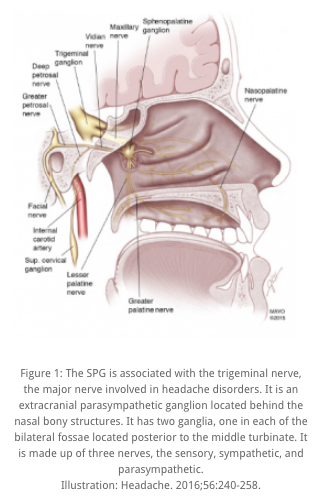
Ever been stumped by the patient with a stubborn headache which nothing seems to be helping?  An intractable migraine or relentless post-LP headache? Consider performing an SPG block.

How it works: 

In migraines and cluster headaches, the SPG is involved in mediating parasympathetic outflow causing vasodilation of cranial vasculature. This vasodilation results in the activation of nociceptors in the meninges inflammatory mediators, resulting in classic migraine-type pain. An SPG block is theorized to mitigate headaches arising from this pathway.

Screen Shot 2018-12-12 at 9.26.59 AM.png


How it's done: 

Steps:

1.   Place patient on monitor. Although you are using below-toxic dose of local anesthetic, the nasal mucosa is highly vascularized. Have patient lie supine in the sniffing position.

2.   Cut off red cap from Qtip from used for swab culture; the Qtip is hollow. Using a blunt 18 gauge needle, draw up 1-2mL of bupivicaine without epithat is well below the toxic dose (ex: 2mL of 0.25% bupivicaine for 70 kg patient) into a syringe.

3.    Thread the blunt needle onto the Qtip.

4.    Dip the cotton end of the Qtip into 2% viscous lidocaine.

5.    While patient supine and in sniffing position, GENTLY insert the Qtip straight into one nare until resistance is met. GENTLY adjust the angle slightly superiorly. Do not push against resistance.

6.   Inject the bupivicaine through the Qtip.

7.   Remove the syringe along with the blunt needle while keeping the Qtip in place. Instruct patient to remain supine for 10-15 minutes.

8.   After 10-15 minutes, remove Qtip. If patient experiences hemifacial pain relief, offer to repeat the block via the other nare. 

*note there are other variations, please see links 

Note that procedure must be done with patient supine

Note that procedure must be done with patient supine

Side effects:

  • Bitter taste from the anesthetic

  • Nausea

  • Local trauma causing epistaxis

  • Light-headedness

  • Numbness in the posterior pharynx

Data: 

 No large trials available, but small studies and case reports are promising.

https://www.acepnow.com/article/migraine-care-why-and-how-to-block-the-sphenopalatine-ganglion-nerve/?singlepage=1

 · 

Gastrointestinal Bleeding: The Next Frontier (for TXA)

IMG_0033.png

TXA has been shown to improve outcomes in cases of bleeding including postpartum hemorrhage (WOMAN trial), trauma (CRASH-2 trial), epistaxis, oral bleeding and even inhaled TXA for hemoptysis (shout out to Dr Bogach for a recent case of this).  It’s low rate of complications (remember its antifibrinolytic, NOT prothrombotic) makes it a great choice for controlling bleeding.  

IMG_0032.jpeg

Given its success in controlling hemorrhage from these sources, there has been investigation into the use of TXA in other kinds of bleeding including ICH (TICH-2 trial showed promising but inconclusive results, needs to be streamlined) and TBI (CRASH-3 trial, ongoing). Gastrointestinal bleeding (GIB) is a 

A Cochrane review on the use of TXA I'm GiB was conducted in 2012, which showed no change in transfusion needs, surgery or bleeding.  Another systematic review was conducted in 2014 that showed a reduction in mortality but noted that several of the studies used had some design flaws.  Additionally, the number of subjects in the combined studies was below the number needed to reliably find a significant result. 

Currently, the Hemorrhage ALleviation with Transexamic acid - InTestinal system Trial or HALT-IT Trial in Great Britain (I would have gone with Patient Oriented Outcomes in GiB or Stop Hemorrhage In Intestinal Tract but it is what it is) is currently enrolling patients with a goal of 8000+ subjects by summer 2019.  Treatment arm will consist of 1g IV bolus dose and then 3g IV over 24hrs (compared with CRASH-2 which gave 1g IV bolus with another 1g IV over the next 8hrs) with the control receiving NS.  Currently, TXA is not included in current recommendations in the management of nonvariceal GIB. However, given its utility in other types of bleeding and it's low risk of complications, it could be considered in severe cases. 


Summary: No evidence to support TXA in GIB but hopefully there will be some data coming out within the next year. Consider it in cases that are refractory to standard of care. 

Would live to hear from anyone with experience with using TXA for GiBs. 

The TRs

 ·