
POTD: Wellness. You Do You.

As we residents, ED attendings, medical students know, finding time for wellness can be a challenge, especially in the face of contiguous shifts, conferences, and multiple inversions of our sleep schedule. It can feel like the weight of Atlas’ world is resting on your shoulders. My intention with this POTD is to reflect on the lessons I have learned navigating self-care in residency, in the hopes that it will prove helpful to someone.  

After perusing articles by wellness gurus and our own PD, Dr. Arlene Chung, I realized that what I do for wellness is different that what many people do. At first, I thought that the difference between my experience and experts meant that I wouldn’t have anything to contribute, but then I realized that wellness is personal, and maybe my experience will prove helpful for someone who reads this POTD. The following are my tips for wellness: 

GENERAL:

First and foremost, approach all advice regarding wellness with curiosity and skepticism, including my own. It might be right for you.  It might not. My intention is not to write you a to-do-list, but to help you examine some areas of your life that may have potential for exercising self-care.  Experiment and see what’s right for you.  

FOOD:

Some residents don’t eat on shift. If this is a choice, either as an intentional approach to intermittent fasting, or because you don’t need to, then that's great. However, it needs to be a choice. Experiment, and learn who you are and follow what’s best for you. If you need to eat regularly, then prepare for this need. 

I bring hydration and food from home and eat before coming to shift. There is not always time to go out and grab something and I enjoy bringing food from home. Waking up early to prep food for myself is a form of self-care. I feel prepared, and loved by myself, when I can grab a frozen Tupperware meal from the fridge. The same is true when I can enjoy a nutella sandwich. I also enjoy prepping a meal/snack for my loved one.  We can go a few days without seeing each other on a long stretch, and knowing that we have that connection through a prepared food is like a lifeline to connect us when we can’t physically be together.

Also, I get hangry. Nutella keeps the Bruce Banner version of Allie in the ED, so no one has to get their rapid strep test from the 8 month pregnant Hulk version of Dr. Kornblatt.  

MEDITATION:

When I come home, I often will feel my brain racing and have thoughts of patient tasks zipping in and out, causing me to stress and have dreams about patient care. So before bed, I actively try and clear my mind to think of nothing at all. Sometimes if I’m having a rough time with this, I use a body scanning meditation technique so that I can focus. I recommend the free first ten guided medications on the app “Headspace.” (I am not paid to endorse Headspace, or a meditation expert at all). The more you practice, the easier it gets and I find in stressful situations, I can clear my mind so that I focus on the task at hand.

SCHEDULE ACTIVITIES IN ADVANCE:

If you see you have a weekend off, schedule something in advance. In my experience, if you wait until that weekend itself, you’ll just sit at home and not do anything. If you do need that time at home to recharge, then plan that, ahead of time. Planning for a weekend under the covers can make it feel intentional, and relieves any guilt associated. 

FINAL TAKE HOME THOUGHTS ON WELLNESS:

We often think of our accomplishments in numbers: test scores, numbers of procedures/requirements completed, class rank, etc. Sometimes this is helpful—comparison to our peers let’s us know if we are falling behind, or in a position to act as a leader and help our colleagues succeed. Not so with wellness. 

Wellness is not comparable, it is not a competition on who is the most well. Experiment and find what’s right for you. If you try to compare or adopt the habits of others, you are destined for disappointment.

So, go be well, whatever it means to you.

Your friendly TR this month,

Allie
 · 

POTD: Sleep Hygiene

The term “sleep hygiene” refers to a series of healthy sleep habits that can improve your ability to fall asleep and stay asleep. These habits are a cornerstone of cognitive behavioral therapy, the most effective long-term treatment for people with chronic insomnia. CBT can help you address the thoughts and behaviors that prevent you from sleeping well. It also includes techniques for stress reduction, relaxation and sleep schedule management.

Here are some general tips for good sleep habits from the CDC:

  • Be consistent. Go to bed at the same time each night and get up at the same time each morning, including on the weekends (this one is admittedly hard for the ER doctor, especially as a resident!)

  • Make sure your bedroom is quiet, dark, relaxing, and at a comfortable temperature

  • Remove electronic devices, such as TVs, computers, and smart phones, from the bedroom

  • Avoid large meals, caffeine, and alcohol before bedtime

  • Get some exercise. Being physically active during the day can help you fall asleep more easily at night.

If you’re still having difficulty falling asleep, consider keeping a two-week sleep diary to analyze your sleep trends.

In our modern-age of electronics, here are some tips to effectively manage electronic screen time in preparation for sleep:

  • Set your iPhone to “Do Not Disturb”

    • This will prevent your phone from alerting you with text messages or phone calls while you’re sleeping. Critical calls will still make it through if you toggle the “repeated calls” setting (i.e. a second call from the same person within 3 minutes will not be silenced)

    • You can also have automatic message replies if people attempt to call you when “do not disturb” is turned on

    • You can schedule when “do not disturb” is turned on

    • You can ensure that certain phone calls will always go through

    • Essentially there is NO REASON why this button shouldn’t be turned on!

  • If you have an Apple Watch, in addition to “do not disturb,” you can place your watch on “theater mode”

    • This will prevent your watch from lighting up with movement while you sleep

  • Download sleeping apps:

    • Sleep tracking apps

      • Sleeptracker

      • Sleep Watch

      • Sleep Cycle

    • Sleep sounds:

      • Relax Melodies

      • Sleep Sounds by Sleep Pillow

      • White Noise Deep Sleep Sounds

What about melatonin?:

Melatonin production in humans has a pronounced circadian rhythm; nocturnal plasma melatonin concentrations are at least 10-fold higher than daytime concentrations. The nocturnal rise in melatonin secretion plays an important role in the initiation and maintenance of sleep.

Nocturnal melatonin plasma concentrations decline with age; many older adult individuals develop age-associated insomnia (eg, waking up during the night, diminished sleep efficiency). Physiologic doses of melatonin may be beneficial for these individuals. Exposure to light suppresses the normal nocturnal rise in plasma melatonin concentrations. Can use low, physiologic doses (0.1 to 0.5 mg) for insomnia or jet lag. High-dose preparations raise plasma melatonin concentrations to a supraphysiologic level and alter normal day/night melatonin rhythms. 

In a randomized, double-blind, replicated crossover trial performed on EM residents in 2018 regarding melatonin vs placebo in regards to sleep efficiency, it was found that there was essentially no difference in sleep quality between the groups, although a minor decrease in drowsiness was found in the melatonin group.

My take away is that good sleep hygiene practices supersede any supplements to promote healthy sleep.

References

https://www.cdc.gov/sleep/about_sleep/sleep_hygiene.html

http://sleepeducation.org/essentials-in-sleep/healthy-sleep-habits

https://www.uptodate.com/contents/physiology-and-available-preparations-of-melatonin?search=melatonin&source=search_result&selectedTitle=1~108&usage_type=default&display_rank=1

https://www.ncbi.nlm.nih.gov/pmc/articles/PMC6117540/ 

 · 

POTD: Chest Tube/Pig Tail Drain Suturing

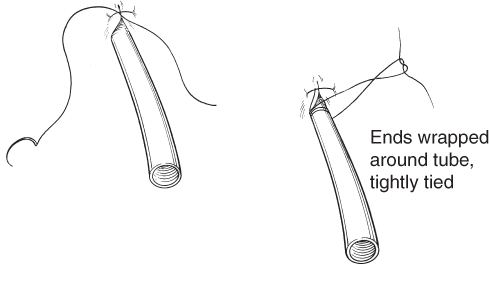
There are several different techniques, so I wanted to illustrate a few of them. The common theme is start from above or below the chest tube and throw your first knot to the skin:

1) Wrapping technique (this is my go-to technique)

- begin by throwing your first knot into the skin above the tube, then wrap the suture material around the base of tube (at the level of the tube insertion site)multiple times and then tie into place

- this can be repeated from below the tube for extra security

- video: https://www.youtube.com/watch?v=v2y-g0RAImw

mint_c044f006.gif

2) The “ps and qs” technique (here called the easy L)

- essentially throw your first stitch in the skin and then perform 3 “p” stitches or 3 “q” stitches and vice versa

- finish by performing hand ties

- video: https://www.youtube.com/watch?v=Qsq1fPxYNrQ

3) The “big S” technique

- similar to a nautical knot, called the clove hitch

- essentially form an “S” shape underneath the chest tube (after you throw your first stitch)

- video: https://youtu.be/4lkyq7U6fpg

Other techniques include purse string sutures or horizontal mattress sutures.

 ·