
We’ve reviewed the most commonly abused hallucinogens in previous POTD, but how do you recognize and treat a patient that has “licked a toad”? And how would you treat a college student who got high off nutmeg? Here we discuss several less commonly abused hallucinogens:
Salvia
▪ Salvia divinorum
▪ a.k.a, “Salvia” “Sally” “Magic Mint”
▪ Smoked or chewed
▪ Not currently regulated under the U.S. Controlled Substances Act
▪ Symptoms/Effects: Visual hallucinations, object and body distortions, dysphoria, incoordination, dizziness, slurred speech
▪ Duration: Up to 30 minutes
▪ Treatment: Supportive
Bufotoxins
▪ bufotenine and 5-methoxy-dimethyltryptamine from venomous toads
▪ also contains cardioactive steroids, and catecholamines
▪ a.k.a., “love stone” “rock hard”
▪ Obtained from extract or “licking a toad”
▪ Symptoms/effects: Powerful psychedelic, GI irritation, salivation, n/v, cardiac toxicity similar to acute digoxin poisoning, hyperkalemia, bradycardia, AV block, Vtach, Vfib, cardiac arrest
▪ Serum digoxin immunoassay often positive
▪ Treatment: Atropine for bradyarrhythmias, may require pacemaker; antiarrhythmics for ventricular arrhythmia; dig-Fab Ab treatment has been effective
Morning Glory Seeds
▪ Ipomoea violacea, Ipomoea tricolor, etc
▪ Contain compounds similar to LSD
▪ Seeds ingested for their hallucinogenic effects
▪ Symptoms/effects: Similar to LSD
▪ Treatment: Reassurance, benzodiazepines in severe cases
Nutmeg
▪ Myristica fragrans
▪ Active compound: myristicin
▪ Large amounts of nutmeg (1-3 nutmeg seeds) can cause delirium with hallucinations
▪ Symptoms/effects: Hallucinations, tachycardia, flushing, dry mouth, nausea, abdominal pain
▪ May resemble anticholinergic poisoning, but pupils are small or normal
▪ Duration: 6 to 24 hours
▪ Treatment: Supportive
Jimson weed and Angel’s Trumpet
▪ Datura stramonium and Datura candida, respectively
▪ Contain atropine, scopolamine, and hyoscyamine
▪ Seeds/other parts of plant ingested or smoked
▪ Symptoms/effects: Delirium, hallucinations, seizures, anticholinergic effects
▪ GI emptying delayed and small seeds can become trapped in GI folds after ingestion
▪ Treatment: Consider GI decontamination in select cases with whole bowel irrigation for large ingestions, avoid anticholinergic medications, may try physostigmine
Source: Tintinalli’s Emergency Medicine, 9th Edition, Chapter 188: Hallucinogens pp 1247-1248
- EMS
- Trauma
- POCUS
- Procedures
- Cardiovascular
- Ultrasound
- Infectious Disease
- Respiratory / Pulm
- Obstetrics / Gynecology
- Orthopedics
- Special Topics
- Wellness
- Critical Care
- Pediatrics
- Toxicology
- Endocrine
- Airway
- EKG
- Medications
- Neurology
- Pharmacology
- Dental / ENT
- Ophthalmology
- Environmental
- Medical Legal
- Dermatology
- Psychiatry
- Gastroenterology
- Hematology / Oncology
- Nephrology / Renal
- Radiology
- Urology
- Wound Care
- Admin
- Nerve Blocks
- Vascular
- EM
- Emergency
- Emergency Medicine
- Benzodiazepines
- DVT
- Foreign Body
- Anal Fissure
- Bupivacaine
- Corneal Foreign Body
- Dialysis Catheter
- Diverticulitis
- Finance
- Gabapentin
- Galea Laceration
- November 2026
- January 2026
- December 2025
- November 2025
- October 2025
- September 2025
- August 2025
- July 2025
- May 2025
- April 2025
- March 2025
- February 2025
- January 2025
- December 2024
- November 2024
- October 2024
- September 2024
- July 2024
- June 2024
- May 2024
- April 2024
- March 2024
- February 2024
- January 2024
- December 2023
- November 2023
- October 2023
- May 2023
- February 2023
- January 2023
- December 2022
- November 2022
- October 2022
- September 2022
- August 2022
- July 2022
- June 2022
- May 2022
- April 2022
- March 2022
- February 2022
- January 2022
- December 2021
- November 2021
- October 2021
- September 2021
- August 2021
- July 2021
- June 2021
- May 2021
- April 2021
- March 2021
- February 2021
- January 2021
- December 2020
- November 2020
- October 2020
- September 2020
- August 2020
- July 2020
- June 2020
- May 2020
- March 2020
- February 2020
- January 2020
- December 2019
- November 2019
- October 2019
- September 2019
- August 2019
- July 2019
- June 2019
- May 2019
- April 2019
- March 2019
- February 2019
- January 2019
- December 2018
- November 2018
- October 2018
- September 2018
- August 2018
- July 2018
- June 2018
- May 2018
- April 2018
- March 2018
- February 2018
- January 2018
- December 2017
- November 2017
- October 2017
- September 2017
- August 2017
- July 2017
POTD: 3 Common Anti-Vaxxer Beliefs
“It is better to light a candle than to curse the darkness” - Carl Sagan
In an era where “fake news” threatens the fabric of our society, we as physicians have a duty to educate our patients and fight the insidious creep of disinformation. We often think of anti-vaxxers as granola-eating, compost pile-making eccentrics living off the grid somewhere in Montana, when the truth is that even some amongst own hospital colleagues may espouse these beliefs.
Here, we discuss three common arguments made by anti-vaxxers in supporting their stance and counterarguments based on empirical evidence we may use to challenge them.
FALSE: Vaccines cause undue harm due to antigenic overload
▪ A misconception propagated by Robert W. “Doctor Bob” Sears that holds infants are incapable of responding safely to the “large number” of vaccine antigens given and that antigenic overload results in a “cytokine storm” or “immune cascade” that triggers adverse health events.
▪ Not surprisingly, “Dr. Bob” failed to cite any data to support this claim.
Counterarguments:
▪ From the moment of their birth, infants encounter numerous microorganisms and their antigens at a level far exceeding the antigen exposure due to vaccines.
▪ Numerous studies show that vaccines are safe and efficacious at the routine vaccine schedule with no evidence of an “antigenic overload.”
▪ Infants and children today actually receive far less antigenic “exposure today” with routine vaccination than they did in the past. The smallpox vaccine given in the 1900s contained 200 proteins and the whole cell pertussis component of DTwP vaccine given in the US up until the 1990s contained approximately 3,000 proteins. Today, the entire schedule of 15 recommended vaccines from birth to age 5 contains no more than 150 proteins and polysaccharides.
FALSE: Vaccines can result in autoimmune diseases such as T1DM, MS, and GBS.
Counterarguments:
▪ A panel of experts of the Institute of Medicine recently reviewed more than 12,000 published reports and failed to find any evidence whatsoever for the development of any of these three autoimmune diseases as a result of vaccines.
▪ The diversity of antigens presented during “natural” infection support the counterclaim that infections are more likely than vaccines to result in autoimmune phenomena, such as influenza virus or Campylobacter infection causing GBS.
FALSE: Immunity produced by “natural infection” is safer than vaccine-induced immunity.
Counterarguments:
▪ Wild type influenza kills 1 in every 8,300 Americans. No deaths have been attributed to the flu vaccine.
▪ The flu vaccine does not cause myocarditis, PNA, bronchitis, sinusitis, or significant amounts of lost work and school time — but “natural” influenza certainly does.
▪ While “natural” measles virus infection does provide lifelong immunity, it also causes death in about 1 out of every 3,000 cases, as well as other non-lethal and disabling complications. The measles vaccine has not been associated with death or disabling complications, despite billions of vaccine doses given.
Harms done by the anti-vaccine movement
▪ The anti-vaccine movement has successfully pressured numerous countries to discontinue use of the pertussis vaccine. These countries now have a documented 10- to 100-fold increased in morbidity and mortality from pertussis.
▪ Doctor Bob Sear’s alternative vaccination schedule has resulted in under-vaccination and measurable increased rates of measles and pertussis.
▪ Europe, Australia, New Zealand, and the Americas are now seeing major outbreaks of measles as a result of Wakefield’s fraudulent study claiming a link between the MMR vaccine and measles.
▪ In a Wisconsin survey, 31% of parents who refused vaccination cited “autism” as their reason.
Poland et al (2012) “The clinician’s guide to the anti-vaccinationists’ galaxy.” Human Immunology, Volume 73, Issue 859-866
POTD: How to Treat Cellulitis...and Leishmaniasis
You diagnose a patient with cellulitis and you reach the old, familiar mental roadblock: which antibiotic do I use? Sure, you treated your last cellulitis patient with Keflex, but this patient has a small, mild abscess — do we use a different antibiotic?
UptoDate is tedious, and you’ve called the ED pharmacy 15 billion times today already for other med recommendations. Is there a better way?
B E H O L D : The IDSA Practice Guidelines
https://www.idsociety.org/practiceguidelines#/name_na_str/ASC/0/+/
From treating cellulitis to combat-related infections to leishmaniasis, the IDSA has the most current recommendations for you, the practitioner.
Back to our patient's skin infection. A quick search will yield this handy chart:
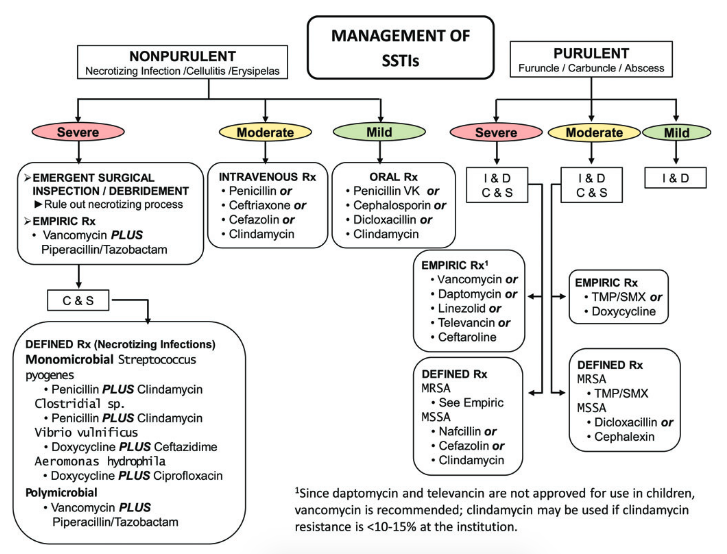
Our patient is young, with no comorbidities, and he has a mild, superficial, purulent infection with no systemic symptoms. According to this chart, we could treat with I & D and NO ANTIBIOTICS AT ALL. However, the same patient with a more deep-seated infection, systemic symptoms, or any risk factors would warrant empiric treatment with doxy or bactrim.
IN SUM: The IDSA practice guidelines exist. Use them.