POTD: Intubating the Pregnant Patient

Intubating a pregnant woman is intimidating because you have two patients to consider. Physiologic changes in pregnancy can affect intubation so it is important to plan ahead.


Both ventilation and acid-base status change during pregnancy. As progesterone rises, there is an increase in tidal volume, which results in maternal respiratory alkalosis. This creates a gas gradient to allow for the transfer of CO2 from the fetus to the mom. This maternal hypocarbia causes uteroplacental vasoconstriction, which can cause fetal hypoperfusion and hypoxia. This creates a very delicate acid-base balance that is exacerbated by increased fetal oxygen consumption and CO2 production in the third trimester. In addition, the diaphragm is pushed up by the gravid uterus reducing the mother's functional residual capacity by 10-25%. As a result of these factors, pregnant patients have a shorter safe apnea time and can desaturate quickly.


Progesterone also decreases the tone of the lower esophageal sphincter. Combined with increased intraabdominal pressure from the gravid uterus, pregnant patients are at higher risk for aspiration. For these reasons, you should be careful with bagging and consider intubating in a semi-upright position. This position also has the benefit of taking some pressure off of the patient's chest and IVC.


Anticipate a difficult airway in pregnant patients. Failed intubation is 8x more likely than in the general population. Human placental growth hormone secreted in pregnancy increases blood flow to the upper airways. This results in edema and hyperemia of the airway, causing it to be smaller and more friable. For this reason, you should prepare a smaller caliber ETT. Rocuronium and succinylcholine have been studied with similar efficacy. Induction agents therefore depend on patient specific factors.


TLDR: 1. preoxygenate well due to shorter safe apnea time. 2. Consider a smaller ETT for a narrower and more friable airway. 3. Limit aspiration risks by decreasing bagging if possible 4. consider intubating patients in a semi-upright position.


Thanks for reading! 

Ariella

References: 

https://rebelem.com/respiratory-failure-and-airway-management-in-the-pregnant-patient/

https://www.nuemblog.com/blog/intubating-the-pregnant-patient

https://www.uptodate.com/contents/airway-management-for-the-pregnant-patient


CXR- Consolidation or Atelectasis?

Here is a quick guide on differentiating consolidations vs atelectasis on chest x-ray.

The reason that we can differentiate structures on x-rays is due to differences in density. For example, the lungs are air-filled and appear black whereas the ribs, vertebrae, and heart are solid and appear white. 

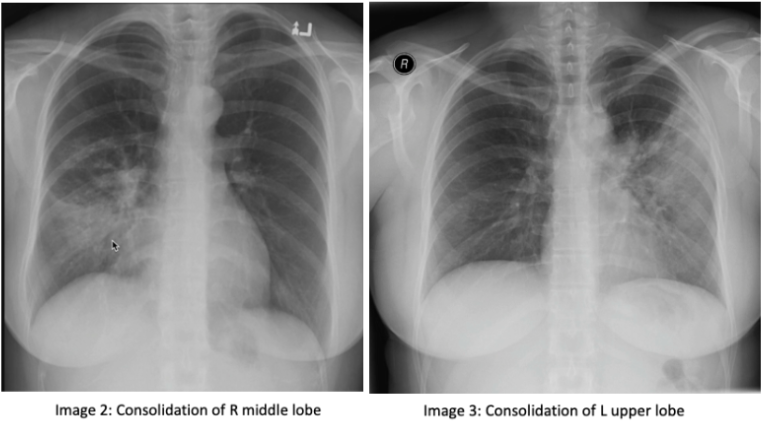
Consolidation: consolidation represents the replacement of alveolar air with fluid, blood, pus, or other substances. There are 3 lobes of the right lung, the upper, middle, and lower lobes. The right middle lobe sits next to the heart border. The left lung has 2 lobes, the upper and lower lobe. The left upper lobe sits next to the heart (image 1). If you have an obscured right heart border, it may indicate consolidation of the right middle lobe (image 2). Similarly, an obscured left heart border may indicate a consolidation in the left upper lobe (image 3). The lower lobes of each lung sit next to the hemidiaphragm. If you cannot make out a hemidiaphragm, it may suggest that there is something of similar density, such as a consolidation, in that lower lobe.

On a normal lateral chest x-ray, the vertebrae should get progressively darker as you get closer to the bases, known as the "more black sign". The vertebrae located near the apex of the lung have overlying muscles, making them appear white, compared to those at the bases that have overlying air, which makes them appear darker (image 4). You should also be able to make out 2 hemidiaphragm on the lateral x-ray with sharp costophrenic angles.

Atelectasis: Atelectasis refers to the collapse of a lung portion. On a normal x-ray, ⅓ of the heart is located on the right and ⅔ of the heart is located on the left side of the chest (image 5). In atelectasis, you will see the mediastinum shift towards the affected side due to volume loss, causing the heart and trachea to shift (image 6). In addition, the unaffected lobe on the ipsilateral side will be hyperlucent as a result of compensatory hyper-expansion. The rib spaces on the affected side may also be closer together when compared to the contralateral side and there may be an elevation of the ipsilateral hemidiaphragm. 

Tip: don’t be fooled by a rotated cxr. Rotation can be assessed by measuring the distance between the medial edges of the clavicles to the vertebral spinous processes. They should be equal or near equal.


Thanks for reading! 

Ariella 

References: 

https://radiopaedia.org/courses/emergency-radiology-course-online/pages/1417

https://radiopaedia.org/articles/lung-atelectasis


US Guided Subclavian Lines

Subclavian lines can be useful when accessing the internal jugular (IJ) or femoral vein is not ideal. For example, you may choose to avoid the IJ in patients who are wearing a c-collar, have a tracheostomy, or have trauma to the head and neck. In addition, some femoral sites are avoided due to pelvic trauma, a large pannus, or a contaminated inguinal region. Using ultrasound to place a subclavian central line can decrease procedure time as well as potential complications, such as pneumothorax, nerve injury, arterial cannulation, thoracic duct injury, hematoma, and hemothorax.

Anatomy: The Subclavian vein is a continuation of the axillary vein as it courses under the clavicle of the first rib and joins with the IJ. The subclavian vein is located inferior and anterior to the subclavian artery. The lung and pleural cavity are deep and interior to the subclavian vein.

There are 2 approaches to placing a subclavian central line: the supraclavicular approach and the infraclavicular approach.

For the supraclavicular approach stand at the head of the bed as if you were placing a central line in the IJ. Place your linear probe above the clavicle to visualize the vein in short axis (you can find the IJ first and trace it until it joins up with the subclavian). Visualize the vein and proceed with Seldinger technique, taking care to note where the pleura is in reference to the vein. You can try to avoid puncturing the pleura by aiming the needle at the rib just under the subclavian vein, so if you overshoot you will be stopped by the rib.

The infraclavicular approach can be done in short or long axis view. If done in long axis, place the probe in the infraclavicular fossa. Your needle in this approach is much more lateral when compared with the landmark-based approach. Identify the point where the axillary and cephalic vein joins with the subclavian and insert your needle past that junction. You will not be able to visualize the artery and vein simultaneously in this view, so use doppler or rotate the probe to short axis so that you can see both the artery and vein at the same time. Proceed with Seldinger technique.

Tip: shrugging the patient’s shoulder opens up a window to puncture the subclavian vein over the 1st rib. In a neutral position, the 1st clavicle lies over the vasculature. Raising the shoulder lifts the clavicle and opens up this space. In this position, if the needle doesn't hit the first rib it will often arch over the first lung, rather than puncture it.

 ·