
Dressing a Central Line Properly

Welcome to one-of-maybe-more series of pearls based off my pet peeves.

Tim’s Pet Peeves Pearls

Magnificent.

Anyways as many of our residents know, central lines placed in the emergency department are frequently changed shortly after transfer to the ICU out of concern that lines were not placed under sterile technique. Not an ideal situation, as repeat catheter placement results in additional risk and discomfort to the patient. 

A year ago I asked one of our (now graduated) ICU fellows about this practice, and he mentioned that when he sees an improperly dressed central line (e.g. dressing partially falling off, not completely sealed), he feels obligated to change the line as it seems less clear whether or not that line was placed under sterile technique and has remained sterile.

While lines may still be exchanged regardless once patients have left our care, we should learn how to best dress and maintain sterility on our central lines. Let’s prevent those catheter-related bloodstream infections!

The lesson today was taught to me a couple years ago by our fabulous resus nurse Minh Duong. 

How to Dress a Central Line

Huzzah, you nailed your central line. Fantastic! Sutured down and everything. Now while you still have your sterile gown and mask on, you open your central line dressing kit. Inside you see a dressing, chlorhexidine swabs, barrier film, and extra PPE.

1. Use your chlorhexidine swabs and clean from inside to outside along the length of the catheter. Clean the line itself! 

Screen Shot 2021-01-10 at 9.59.06 PM.png

2. Flip the swab and go back and forth over the surrounding skin. 

Screen Shot 2021-01-10 at 9.59.50 PM.png


3. Repeat with the remaining swabs (there are multiple swabs in the kit)

4. Allow the site to dry. No need to fan or blow on the site.

Screen Shot 2021-01-10 at 10.04.56 PM.png


5. Take your Sureprep Protective Wipe and draw a rectangle around the catheter site. The dressing will not stick well to the chlorhexidine, but will stick well to the SurePrep barrier film. This is important to make sure the dressing seals properly.

Screen Shot 2021-01-10 at 10.05.50 PM.png


6. Place the dressing over the catheter so that the chlorhexidine-impregnated gel layer overlies the entrance of the catheter into the skin. Important for preventing those catheter infections!
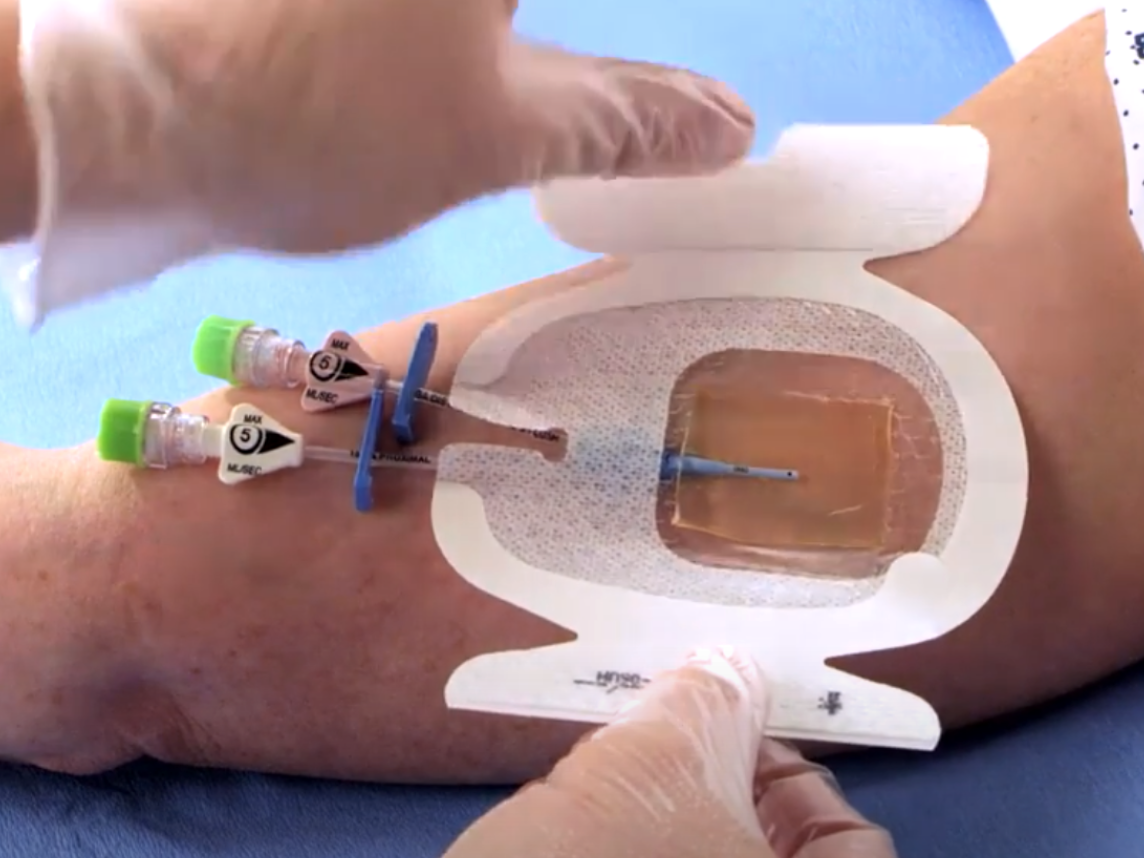

7. Remove the sides of the dressing and press firmly along the sides to ensure that the dressing lies flat along the skin. For IJs, this often requires pulling a small amount of tension along the skin to have the dressing lay flush against the skin along the curves of the neck.


8. Take the next largest piece of the dressing (from the wings of the initial piece) and place it UNDER the catheter but OVER the dressing to create a closed loop around the catheter. Press firmly so the dressing lies flush against the skin.

Screen Shot 2021-01-10 at 10.09.42 PM.png


9. Take the final thin piece of dressing from the remaining wing and apply it overtop the area where the catheter exits the dressing. Label the final piece with the current date.

Screen Shot 2021-01-10 at 10.10.53 PM.png

If applied properly you now have a sealed dressing around a CVC. Do this properly, take a little extra time and your nurses and ICU will love you. Congrats!


Sources

https://www.youtube.com/watch?v=BVZq4WgfzQ4

https://www.youtube.com/watch?v=aMxahVmCR2E

https://www.youtube.com/watch?v=DGL8CzKTgVo


EMS Protocol of the Week - Allergic / Anaphylactic Reaction (Adult and Pediatric)

I love taking requests!


EMS’s approach to anaphylaxis in NYC is explained across 4 different documents:


The four protocols all include degrees of overlap, which can make them a confusing read, but I’ll try to simplify it for you all as best I can. Fortunately, the upcoming version of the protocols for 2021 has a brand new formatting style that makes the transition from BLS to ALS levels of care easier to understand, but we’ll get to that in the coming weeks.


The reason why I’m including the relevant BLS protocols this week is because this is a rare occurrence where BLS can actually give an injectable medication and thus may need to call OLMC for its approval. Protocol 410 (BLS) provides background information on anaphylaxis for EMTs and instructions for evaluating whether epinephrine is indicated. If it is, EMTs are allowed by Standing Order to administer a single dose of IM epinephrine, either via a patient’s own auto-injector, the crew’s auto-injector, or a “Check and Inject” kit wherein EMTs draw the epi into clearly marked syringes, eliminating the need for dose calculations. Whether a crew carries auto-injectors or “Check and Inject” kits comes down to their service’s formulary. BLS crews can then contact OLMC in order to provide a second dose of epinephrine, if needed, so don’t be caught off guard if an EMT calls you with that request. 


Protocol 510 (ALS) also includes Standing Orders for IM epinephrine (allowing paramedics to draw it up themselves) while additionally including obtaining IV access for fluids, diphenhydramine, and steroids (methylprednisolone or dexamethasone), as well as albuterol and advanced airway management if necessary. Medical Control Options for OLMC include repeating any of the previous SOs as well as various pressor options for persistent hypotension (epinephrine drips are not yet an option, although push-dose epinephrine is).


The key distinctions of Protocol 455 (BLS) and Protocol 555 (ALS) is that they include more specific language for pediatric dosing of epinephrine. BLS is also supposed to call OLMC for approval prior to the first dose of epinephrine for a child if there was not previously a prescription for an epinephrine auto-injector, although if the BLS crew is unable to reach OLMC for some reason, they are permitted to give the dose emergently and reattempt contact with OLMC as soon as possible afterwards. 


Hope that didn’t overcomplicate things for you all! Keep reaching out with requests, emailing or texting with questions, and paying your respects to www.nycremsco.org and the protocols binder!


Dave

 · 

Angioedema

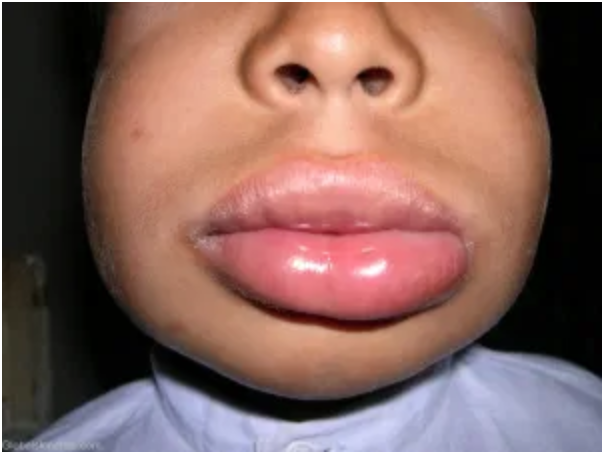
One question that has been visited before, but came up again on recent shifts -- the non-crashing angioedema patient i.e. they do not require intubation. We will save difficult intubations in edematous airways for a different day.

Specifically, the question that came up was eloquently phrased as “Wait, TXA? FFP? Why do we do that again?” Today we’ll touch on angioedema in general but focus on the treatment of bradykinin-mediated angioedema.

Angioedema!

(from https://coreem.net/core/angioedema/)

(from https://coreem.net/core/angioedema/)

What is it?

Paroxysmal, non-demarcated swelling of dermal or submucosal layers of skin or mucosa.
(super exciting, I know).

What flavors are there?

Broadly speaking, we have the mast-cell / histamine-mediated vs bradykinin-mediated vs we-have-no-idea idiopathic mediated. 

angioedema


Yes, that list is from UpToDate. No, I had never heard of Gleich Syndrome. In the emergent setting, we often will not be able to diagnose one of these idiopathic causes and will typically treat it similarly to histamine-mediated.

EMCRIT also has a nice chart that summarizes some of the differences between histamine vs bradykinin mediated.

emcritangioedema.png

Key Points

  • History is SUPER important!

  • The onset of bradykinin-mediated angioedema is on the scale of hours; histamine-mediated is more on the scale of minutes

  • Urticaria more frequently associated with histamine mediated

  • Think about bradykinin-mediated if there is no improvement to antihistamines or steroids!


Treatment Options (The Fun Stuff)

For histamine-mediated, the treatment is similar to how you may treat any allergic reaction of various severities. Diphenhydramine 50 mg IV, famotidine 20 mg IV, IV methylprednisolone 125 mg, IM 0.5 epinephrine.

Let’s focus on the more confusing treatments for bradykinin-mediated angioedema.


Tranexamic Acid (TXA)

Theory: TXA inhibits the conversion of plasminogen to plasmin (which is why we use it for bleeding). But that step is also key to bradykinin generation.

txamechanism.jpg

Does it work?: Jury’s out. There was one study that demonstrated improvement in 27 of 33 patients when treated with TXA alone. https://pubmed.ncbi.nlm.nih.gov/29735174/ The data is otherwise sparse.

Should I try it? Reasonable to try as it’s safe, inexpensive and universally available, although the efficacy is still controversial. Easier to obtain than FFP (which requires thawing).

C1-inhibitor concentrate (Berinert, Ruconest, Cinryze)

Theory: Blocks two key steps in bradykinin generation. 

Does it work?: Generally treated as front-line therapy for congenital angioedema w/ deficient C1-inhibitor activity. Case studies suggest that it may be useful for ACEi-induced or thrombolytic-induced angioedema as well.

Should I try it? Well we don’t have it. And it’s super expensive. 1g IV as a slow push over 10 minutes. 

Fresh Frozen Plasma (FFP)

Theory: If it’s ACEi induced, FFP helps by providing more ACE. If the angioedema is C1-inhibitor deficiency induced, FFP also has C1. Theoretically it should help then reduce bradykinin levels.

Does it work?: Case reports suggest it may be effective for ACEi-induced and hereditary angioedema. A retrospective cohort study found that patients treated w/ FFP were less likely to require intubation. https://www.ncbi.nlm.nih.gov/pubmed/26953061

Should I try it? Reasonable to try. Widely available. 2 units initially.

Icatibant & Ecallantide

Theory:  Icantibant is a bradykinin antagonist. Ecallantide is a kallikrein inhibitor (which then blocks the production of bradykinin)

Does it work?: The “FAST” trials (For Angioedema Subcutaneous Treatment) overall suggest that icatibant reduces times to reduction in symptom severity specifically in patients with C1-INH deficiency. Newer studies suggest icatibant is ineffective against ACEi-induced angioedema (https://pubmed.ncbi.nlm.nih.gov/27913306/). Overall ecallantide has not been significantly more effective compared to placebo in RCTs.

Should I try it? Well we don’t have it. And it costs 10k. So not a reasonable option for most emergency departments, including ours.

So What Should I do? Take Home Points!

Emcrit has a much more in-depth explanation and a great algorithm that can be found here. https://emcrit.org/ibcc/angioedema/#algorithms

But in short.

  1. If unstable, intubate (carefully)

  2. Take a good history and decide if it sounds more histamine-mediated or bradykinin-mediated

  3. If suspect histamine-mediated (or unsure), reasonable to trial antihistamines +/- steroids

  4. If step 3 doesn’t work or suspect bradykinin, reasonable to trial TXA and FFP.

  5. Still not working? See if you can get C1-inhibitor concentrate! (Spoiler, you probably can’t)

Sources

https://coreem.net/core/angioedema/

https://www.uptodate.com/contents/an-overview-of-angioedema-clinical-features-diagnosis-and-management

https://emcrit.org/ibcc/angioedema/

https://www.uptodate.com/contents/an-overview-of-angioedema-pathogenesis-and-causes