
Stepping outside and feeling the frosty air helped me pick the topic for today: Frost bite!
Frost bite is a cold injury when ice crystal formation intracellularly and extracellularly cause cell injury and death leading to tissue injury.
Pathophysiology:
At first the cold causes cell death with ice crystal formation. Then once thawing begins, there is a lot of inflammation, vasoconstriction of vessels, thrombus formation and emboli in small vessels. This causes more ischemia, cell death and leads to necrosis.
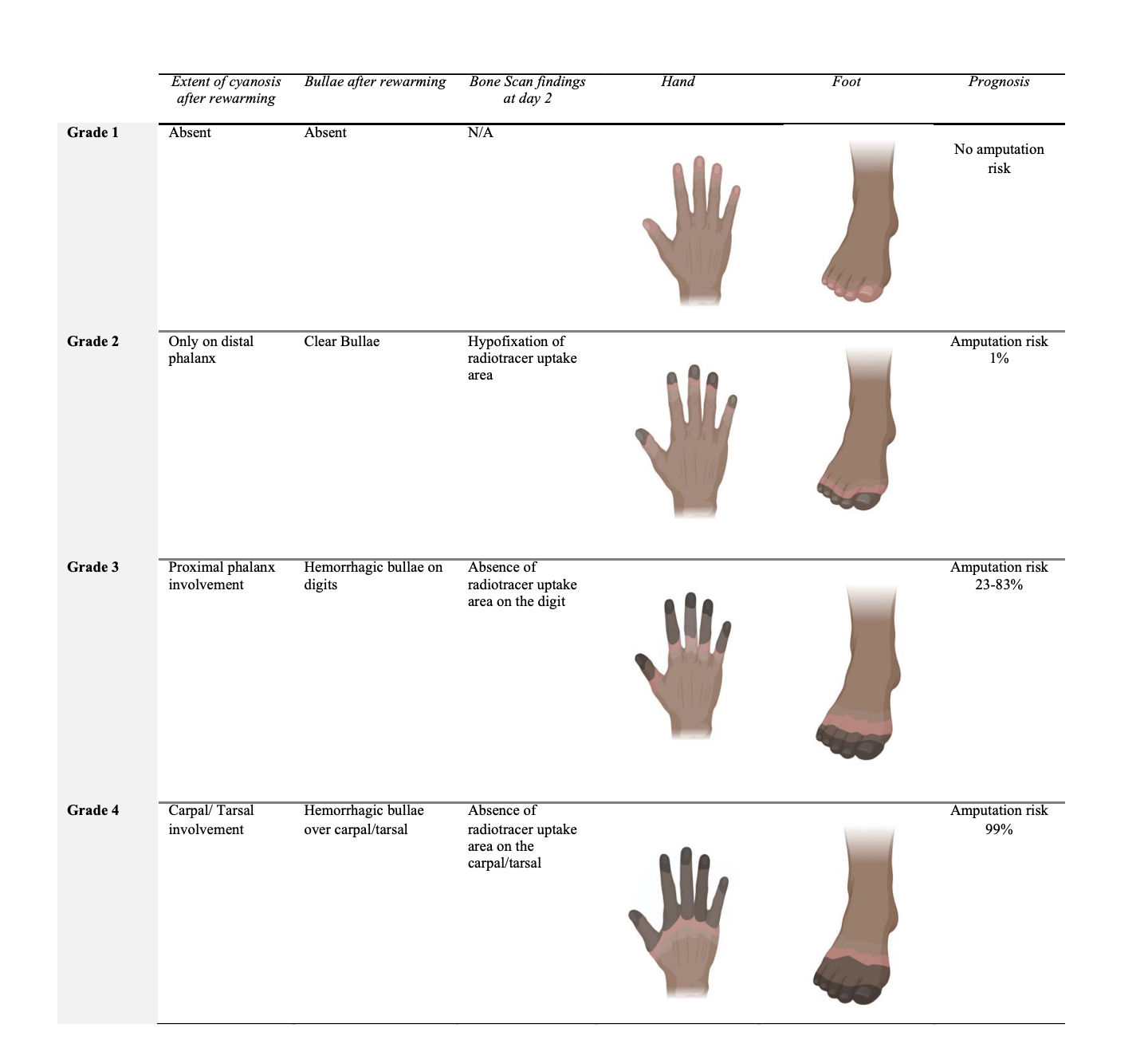
There are different ways to classify frostbite with Cauchy et. al’s used the most. This grading is done after rewarming because it can be hard to tell the extent of injury beforehand.
Upper and lower extremities are most commonly affected but frostbite can also occur on other exposed skin such as the nose or ears.
Before arrival to the ED, do not start rewarming!
Refreezing of thawing tissue worsens the damage being done.
First Steps when someone arrives to the ED with frostbite:
Remove wet clothes
First step is to assess for hypothermia and treat moderate to severe hypothermia first.
Next will be to warm the affected area:
Keep in mind this can be very painful!
Rewarm the area with water that is around 37-39 degrees celsius. Ideally the water should be circulating like in a whirlpool.
I don’t think we have this available in the ED but you can consider if it’s a hand having your patient by the sink and keeping the water running.
Patient should be directed to slowly move the extremity
This treatment should continue until tissue is red, purple or soft (about 15-30 minutes)
Provide TDAP
Treatment:
* Of note, while Iloprost has been approved in the US it is not available for use. Further research also needs to be done to determine if it is beneficial over just using thrombolytics
If Grade 1 frostbite, Frozen > 24 hrs, Thawed > 72 hrs, freeze-thaw-refreeze
wound management is what can be offered
If the frost bite is grade 3 or 4
If thawed < 24hrs,
thrombolytics can be considered after reviewing contraindications
If thawed > 24 hrs,
Cannot give thrombolytics
If thrombolytics can be given do that first, then for these grades you can give Iloprost IV infusion for 8 days
If Grade 2 or 3
Can offer patient 8 day hospital stay for Iloprost infusion
TLDR:
Do not rewarm if there's a chance of the injury refreezing
Treat moderate and severe hypothermia first
Able to grade the severity of injury after rewarming
Thrombolytics can be offered for grade 3 or 4 if thawed < 24hrs
Iloprost can be offered after thrombolytics, if grade 3 or 4, or even if grade 2 or 3.
Wound care management for everyone
TDAP
Iloprost is associated with lower amputation rates but further research still needs to be done.