
Today we'll go in the opposite direction of frostbite and talk about burns. While Maimonides is not a burn center, we still do get burn patients coming in.
Classifying Burns:
We no longer use 1st, 2nd or 3rd degree but based this off the depth of the burn
Superficial thickness: involves the epidermal layer only
Skin looks red
Superficial partial thickness: involves the superficial dermis.
Can cause blisters, looks wet, more painful
Deep partial thickness: involves the deep dermis
Looks cherry red or pale, now causing delayed cap refill
might be less painful now
Full thickness: Involves all the layers including fascia, muscle, bone
looks white, waxy, leathery. No cap refill
usually painless in that area
Burns can worsen over time and the full extent may not be known immediately
Estimating Burn size:
Only include partial and full thickness used to estimate seize.
Rule of 9's and the Palmar Method are two ways to estimate the size of the burn
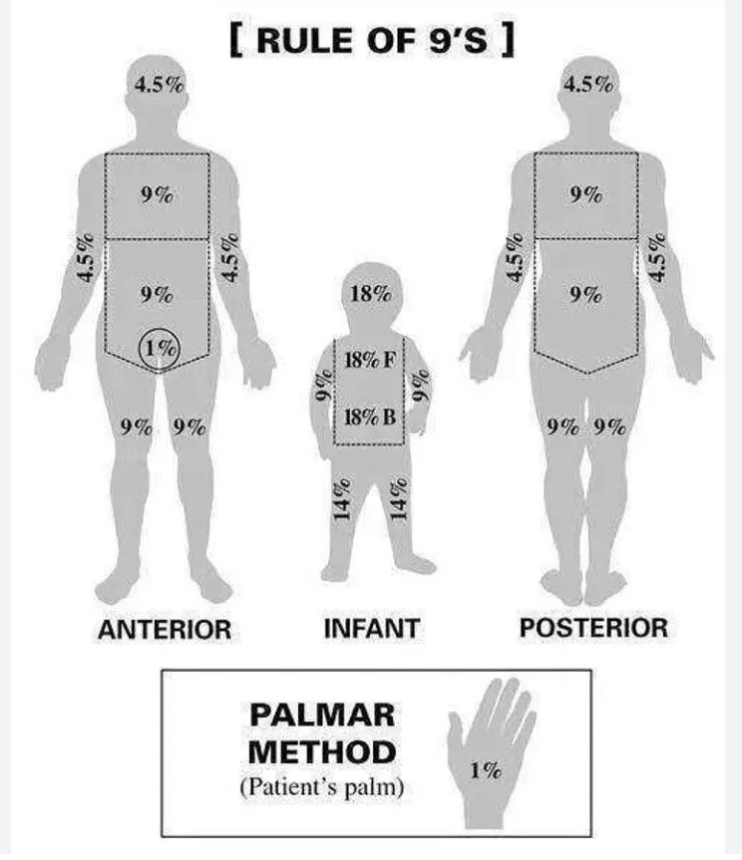
Wound Care:
Run wound under cold water if possible and you can use soap to clean it. Avoid ice or toothpaste as this may worsen the injury.
Keep the wound moist to aid in healing and use a non-adherent pad
Silver Sulfadiazine used to be recommended but may actually slow healing so no longer recommended. Bacitracin can be used for superficial wounds.
Blisters: sloughed, necrotic or ruptured blisters can be debrided but otherwise small unruptured blisters should be left alone.
Airway Considerations:
Keep a high suspicion for impending airway compromise. There may be inhalation injury.
Signs for early intubation include: respiratory distress, stridor, hoarseness, burns to the face and neck, blisters in the oral mucosa
You can also consider using a scope to visualize patient's supraglottic area to see if there is edema, erythema
Indications for ED Escharotomy:
Escharotomies in burn patients are considered when the injury is extensive enough to cause compartment syndrome
Indications include:
Inability to ventilate patient due to burns to the torso, absent or decreasing pulses, neuro deficits
Escharotomy is done to the burn areas with eschar and not to the fascial layers like a fasciotomy
Fluid Resuscitation:
These patients have impaired skin barriers and are likely to be dehydrated and it is important to fluid resuscitate them
Parkland Formula is widely used to calculate the amount of fluids to give to these patients. However there is concern of causing fluid overload and edema.
The Modified Brooke's can be used and this allows for less initial fluids to be given to hopefully prevent fluid overload.
Infection:
These patients are at higher risk for infection. However, the use of prophylactic antibiotics is controversial.
Antibiotics should be given when there is proven infection or the patient is septic.
Indications for transfer:
Full thickness burns
Partial thickness and >/= 10% TBSA
Partial or full thickness involving hands/feet, face, genitals, over joints
Burns with other traumatic injuries
Uncontrolled Pain
Inhalation injury
Chemical Injuries
High Voltage Injuries (>1000)
Lightning Injury